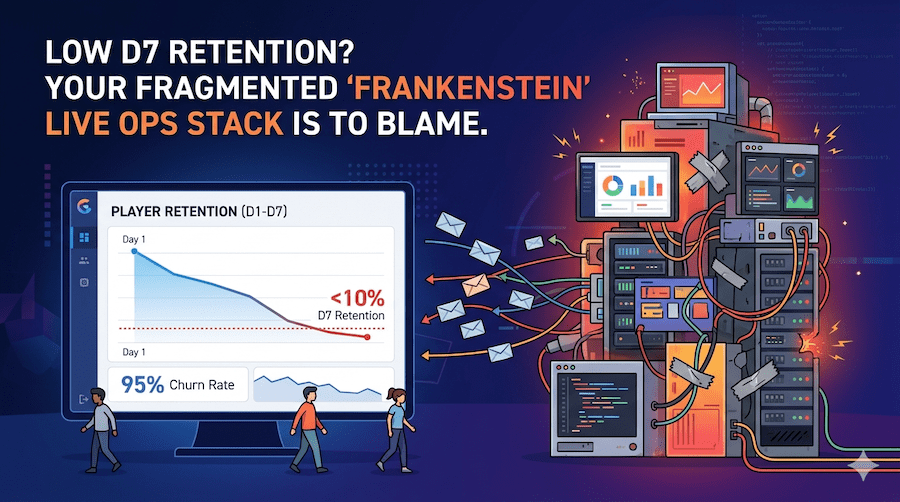
We’ve all been there. You launch a new in-game event, the art is stunning, the mechanics are polished, and the initial UA burst looks promising. But then, the Day 7 (D7) retention numbers roll in, and they’re… well, sobering.
In the current F2P market, a D7 retention rate below 10% isn’t just a hurdle; it’s a death sentence for your game’s economics. When 95% of players churn within the first 30 days, every second of those first seven days counts.
Usually, the instinct is to double down on content. “We need more levels! More skins! A bigger Battle Pass!” But more often than not, studios are trying to fix a data problem with a content solution.
The real culprit? It’s likely sitting right in your browser tabs: a fragmented, “Frankenstein” Live Ops stack that is quietly suffocating your player base.
The Silent Killer: The Data Gap
In a perfect world, your tools would work like a high-performance orchestra. In reality, most mid-core and casual tech stacks look more like a group of soloists playing in different rooms.
- Your Analytics Dashboard sees a high-value player struggling with a specific boss.
- Your CRM is scheduled to send a generic “We miss you” push notification… in two days.
- Your Web Shop is offering a discount on a resource that the player already has in abundance.
By the time your Live Ops team realizes a cohort is churning, they’re working with 48-hour-old data. In the mobile world, 48 hours is an eternity. If you can’t intervene the moment a player hits a friction point, you’ve already lost them.
The Reality Check: You aren’t “running Live Ops” if you’re reacting to what happened the day before yesterday. You’re performing an autopsy.
The “Social Advantage” is Real (If You Can Act on It)
We know from recent industry shifts that social integration is the ultimate retention engine. Players in alliances or social circles retain 3–4x longer than solo players.
But simply having a “Join Alliance” button isn’t enough. The win happens when you can identify a “solo-flier” showing high engagement signals and trigger a personalized nudge toward a relevant guild—in real-time. If your analytics tool doesn’t talk to your CRM instantaneously, that “social nudge” never happens. The player remains isolated, hits a wall, and disappears into the 95% churn statistic.
The Shift: From Content Treadmills to Unified Infrastructure
The studios winning in 2026 have moved past the “more is better” tool philosophy. They realized that having twelve specialized tools is useless if they don’t share the same heartbeat.
The goal is to close the loop:
- Identify a behavioral signal (e.g., a player failing a level three times).
- Intervene with a personalized offer or social nudge (e.g., a free power-up or a guild invite).
- Monetize or Retain based on that specific interaction.
This requires a unified data layer. When your player data, your communication tools, and your economy engine all live under one roof, “Real-Time Live Ops” actually becomes real.
Meet PULSE: The Antidote to the Tangled Stack
At PULSE, we built our unified backend platform because we saw too many brilliant games fail due to “software friction.” We don’t believe you should have to spend your week stitching together APIs just to send a relevant push notification.
PULSE provides a unified data pipeline combined with AI-native agents that act on player signals in seconds, not days.
- No more silos: Your CRM knows exactly what your analytics see, the moment they see it.
- AI-Driven Intervention: Our AI agents can automatically segment players based on real-time behavior and deploy the exact “intervention” needed to keep them in the game.
- Built for 2026: We’ve moved beyond the “dashboard-only” era to an infrastructure that acts for you.
Stop Managing Tools. Start Retaining Players.
Your team’s talent should be spent crafting incredible experiences, not fighting with disjointed software. If your D7 retention is keeping you up at night, it might be time to look past the game design and take a hard look at your live-ops backend tool set.
Ready to see what a unified backend can do for your D7? Let’s talk about simplifying your tech stack with PULSE.