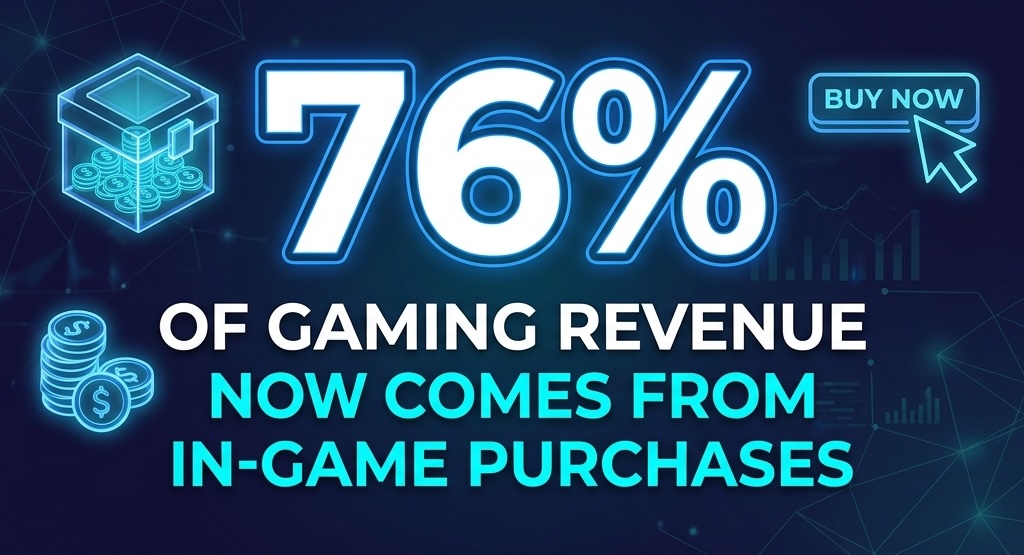
There was a time when “finishing” a game meant seeing the credits roll. Today, finishing a game usually means your credit card statement has reached its limit. If you’ve felt like your hobby is becoming a second mortgage, you aren’t imagining things. A striking new reality has emerged in the industry: 76% of all gaming revenue now comes from in-game purchases.
This isn’t just a stat; it’s a total shift in the tectonic plates of entertainment. Here is why that 76% is the only number that matters in 2026.
The $70 Entry Fee is Just the Cover Charge
Remember the outcry when base game prices jumped from $60 to $70? In hindsight, that was a distraction. While we were arguing over $10, the industry was pivoting to a model where the initial purchase is merely the “buy-in.”
With 76% of revenue generated after the initial sale, developers are no longer incentivized to give you a “complete” experience on day one. Instead, they are building “platforms for monetization.” Whether it’s a $20 skin, a $15 Battle Pass, or a “time-saver” pack, the goal is to keep your wallet open long after the disc (or download) is in the tray.
The Rise of the “Live Service” Graveyard
Why does every game feel like it needs a roadmap? Because it does. To hit that 76% profit margin, games have to be “sticky.”
-
The Problem: We only have so much time.
-
The Result: “Wallet Fatigue.”
When 76% of the money is in the tail-end of the product, developers stop making sequels and start making “seasons.” This is why we see legendary franchises pivoting toward live-service models that often feel more like digital malls than epic adventures.
The Psychology of the “Micro” Transaction
The term “micro” is doing a lot of heavy lifting these days. When a single cosmetic item costs 30% of the price of the actual game, the math has officially left the building.
“Gaming has transitioned from a product you own to a service you rent, and the rent is due every time a new ‘Limited Edition’ skin drops.”
The industry has mastered the art of FOMO (Fear Of Missing Out). By tying that 76% revenue stream to time-gated content, players feel pressured to spend now or lose the item forever. It’s a brilliant business move, but a exhausting one for the player.
The Breakdown: Where the Money Goes
| Category | Impact on Player | Why Developers Love It |
| Battle Passes | Constant “grind” pressure | Guaranteed recurring revenue |
| Cosmetics | Purely aesthetic (usually) | High profit margin, low dev cost |
| Gacha/Loot Boxes | Gambling-lite mechanics | Taps into “Whale” spending |
| DLC/Expansions | Can fragment the player base | Extends the life of the engine |
Is There a Breaking Point?
The “Empty Wallet” syndrome is real. As that 76% number climbs, we’re seeing a growing counter-culture in gaming. The massive success of “complete” indie titles and “one-and-done” RPGs suggests that while the industry loves the 76% stat, the players are starting to crave the 100%—as in, 100% of the game for one price.
The 76% isn’t just a trend; it’s a challenge. It’s a challenge to developers to provide actual value for that extra spend, and a challenge to us, the players, to vote with our digital or physical wallets.
The next time you see a “Mega Bundle” in the store, just remember: you’re part of the 76%. The question is, are you getting your money’s worth?