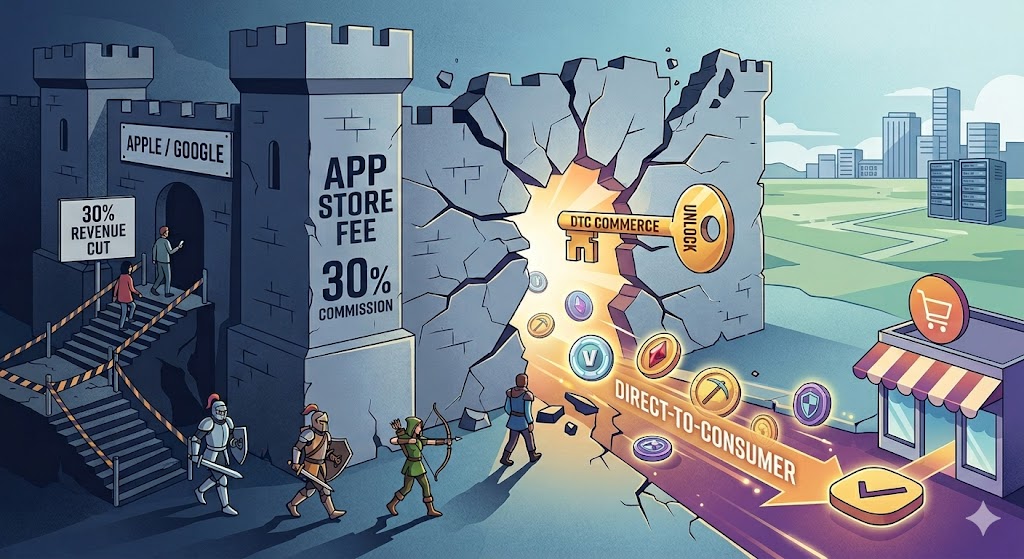
For years, mobile studios treated the app store fee as a fixed cost of doing business. That mindset is changing. Apple’s standard business terms still use a 30% commission on digital goods and services, and Google Play’s service-fee structure still reaches 30% above $1M in annual developer earnings, with lower tiers and subscription exceptions.
The exact mechanics vary, but the economic reality is the same: every dollar that stays inside the app store is a dollar that carries platform tax.
The Cracking Door of Off-App Commerce
The real unlock came when the Epic v. Apple fight cracked open the door to off-app commerce. In April 2025, a US judge found Apple in contempt for violating an earlier injunction tied to the Epic case and moved to bar Apple from collecting commissions on certain off-app purchases; Reuters later reported Apple’s appeal and the 9th Circuit’s refusal to pause the order.
For studios, the message was hard to miss: direct-to-consumer (DTC) commerce is no longer a fringe idea. It is an operational option.
When Margin Becomes Strategy
This shift matters because user acquisition (UA) is not getting cheaper. AppsFlyer reported global gaming app UA spend reached $25 billion in 2025, up 3.8% year over year. Meanwhile, Newzoo put the global games market at $188.8 billion in 2025 and estimated mobile at $103.0 billion—still the largest segment but in a slower-growth phase in mature markets.
When acquisition gets more expensive and top-line growth gets harder to manufacture, margin becomes strategy.
From Side Experiment to Core Infrastructure
The barrier to entry is rarely strategic will. It is technical complexity. That is why web shops are moving from side experiments to core infrastructure. The studios winning here are not just adding another payment page; they are building a commerce layer that can:
- Personalize offers: A returning payer should not see the same incentive as a first-time spender.
- React to behavior: A “whale” should see different bundles than a lapsed free player.
- Update at speed: The storefront needs to move fast enough to matter for live ops.
The Subtle Math of Success
The financial impact is significant. Suppose a game generates $500,000 in monthly In-App Purchases (IAP) and only 10% of that spend is redirected through a web shop. If personalization lifts conversion on top of that, the upside compounds quickly.
- Gross Merchandise Value (GMV): $50,000 outside the app store.
- Monthly Margin Gain: ~$15,000 (at a 30% headline fee).
- Annual Impact: $180,000 from a single 10% shift.
The Pitfall of Generic Solutions
Smart studios need a commerce system that is customizable, fast to iterate, and connected to player data from the start. Generic web shop tools often leave money on the table. Built for speed over depth, they often lack connection to:
- Player Data: They can’t distinguish between user segments.
- Live-Ops Cadence: They can’t be tuned quickly for weekend events.
- Retention Loops: They don’t feed clean signals back into the broader game ecosystem.
Integration as a Competitive Advantage: Pulse by Maglev
This is where Pulse fits. Pulse by Maglev is built around unified live ops infrastructure, real-time player data activation, and AI-native game operations.
In practice, this means your web shop does not live outside the rest of your stack. It is part of the same operating model that drives retention, segmentation, and revenue decisions. Pulse’s fully customizable web shop builder offers:
Baked-in AI Personalization.
Full Code Ownership.
Unrestricted Design.
For founders and monetization leads, the winning shop is not the one that simply exists—it is the one that reflects the brand and reacts to player behavior. Studios that treat web commerce as core infrastructure will not just recover margin; they will build a stronger monetization engine for the future.