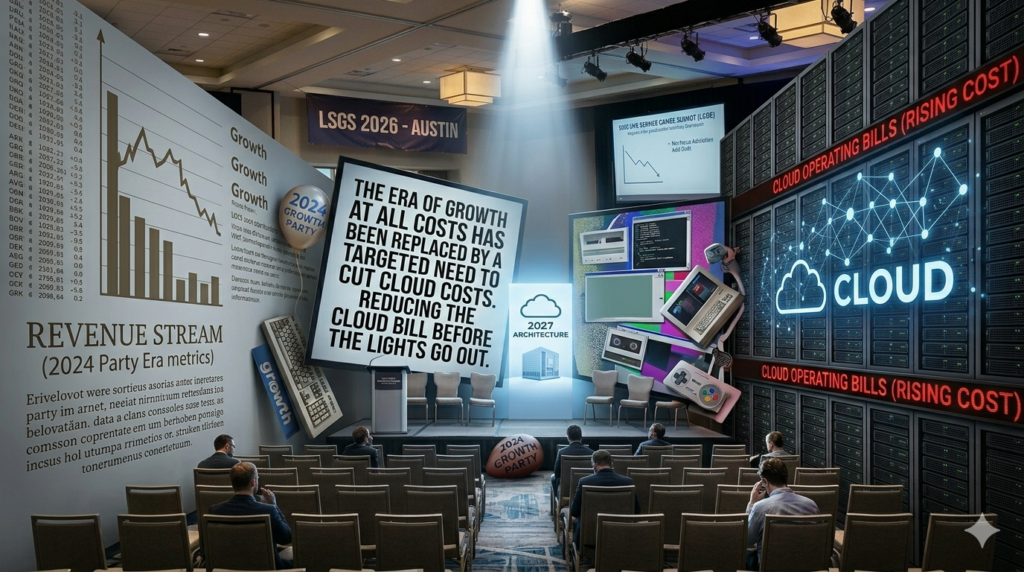
The 2026 Live Services Games Summit in Austin was another excellent conference, the second time it was held, and far more intimate than last year. Attendance was half of what it was the previous year, but the content felt more focused.
The feeling in the attendees was hopeful but measured, we’re all feeling the crush of high costs to run our operations while faced with a failing economy. The big takeaway is that the era of growth at all costs has officially been replaced by a desperate need to cut the AWS bill before the lights go out. We are operating in a world where margins are being squeezed from both ends, and the tools most studios are using were built for a “line-go-up” world that ended with the end of the lockdowns. This is not a temporary dip or a cyclical slump; it is a structural shift in how games have to be built and maintained if they want to actually exist in 2027.
Discretionary Spending Down 50% – Critical Time to Reduce Costs
Tamerlane Barak dropped a statistic during the closing panel that should keep every monetization lead awake at night.
Five years ago, the average US consumer spent about 54 percent of their income on basic necessities like food and rent. Today, that number has ballooned to 76 percent. This means the discretionary “fun money” pool that every game on the planet is fighting for has been effectively cut in half. You cannot simply “optimize” your way into a wallet that is already empty. This is being felt deeply by companies like Scopely, facing the reality of their Marvel Strike Force revenue slump isn’t something growth at all costs folks are prepared to handle.
If players have less to give, and this is both revenue AND time, developers cannot expect player spending to grow. They need to protect margin, reduce infrastructure cost, and get more out of the staff, and data they already have.
Riot Games Cost Focused Management
Maxfield Stewart from Riot gave what was easily the most sobering, operationally grounded talk of the entire summit.
He detailed some of a cost management strategy that has helped Riot run economically efficient despite their fantastic scale. He talked about a deceptively simple tactical change that had immediate financial impact. They were paying full monitoring rates for zero-value log entries. They realized “the one simple trick that DevOps companies hate,” actually was a thing. Riot has also formalized “Cost per Game Hour” as a core strategic concept and metric, which is a move every studio should have made years ago.
If you’re not modelling you all-in costs of ownership, then your mid-sized studio is likely hemorrhaging cash you don’t even know you’re losing. The reality of the day is that the most reliable and meaningful way to preserve your company is to make sure AWS and your fragmented service providers don’t put you in an early grave.
Until now, the industry lacked tools that can surface cost per hour versus revenue per hour on a per-player or per-game basis. We have been flying blind in a storm, and our instruments are telling us how many people are in the plane but not how much fuel we have left. This is the exact gap that Pulse was built to fill, and seeing the scale of Riot’s efficiency focus only confirms that the “unified data” narrative isn’t just marketing speak. It is a literal life raft.
Keeping Data Messy is a Defensive Strategy
Emma Alvarez made a point that was both brilliant and depressing: her team intentionally keeps their data unstructured to preserve “vendor flexibility.”
This is a massive red flag for the current state of the analytics market. It means that studio leads trust their vendors so little that they would rather deal with the headache of messy, unstructured data than get “locked in” to a platform that might fail them or hike prices next quarter. Oscar Clark echoed this sentiment, calling for a formal industry standard for how game data is actually structured and reported.
We are in a fragmented nightmare where every tool speaks a different language, and the people paying for those tools are tired of being the translators.
Simulation is Crucial to Survive a 4x Economy
Dominic Gelinau touched on a pain point that is specific to complex games but carries a universal lesson: we are terrible at predicting our own game economies.
He argued for agentic economy simulation tools that allow developers to test “reward and sink” curves before they ever hit a live server. Right now, most studios adjust their economy, ship it, and then pray they didn’t accidentally create a currency arbitrage loophole that a crafty player economy can exploit. (I think we’ve all been there). A healthy economy follows a wave pattern, but visualizing and maintaining that pattern is still an unsolved problem for most of the industry.
If you can’t simulate the impact of a new item or currency before it goes live, you aren’t running a service; you’re gambling with your company’s bank account. Our economic analyst AI agent is designed precisely for supporting economy designers in this task. Simulate, iterate, test, ship is our core economy loop thanks to our pioneering into generative economics.
The Efficiency War is Just Begun
The studios that survive the next three years will be the ones that focus on the brutal reality of their margins. You need to know exactly what it costs to keep a single player in your game for a single hour, and you need to know that your data isn’t just sitting in a silo waiting for a vendor to hold it hostage. The LSGS conversations made one thing very clear: the demand for a unified, cost-conscious, and actually intelligent live ops stack is no longer a “nice to have.”
It is the only way to keep the lights on in a world where discretionary spending is tighter than ever before.
We’ve got the solution, are you a survivor?