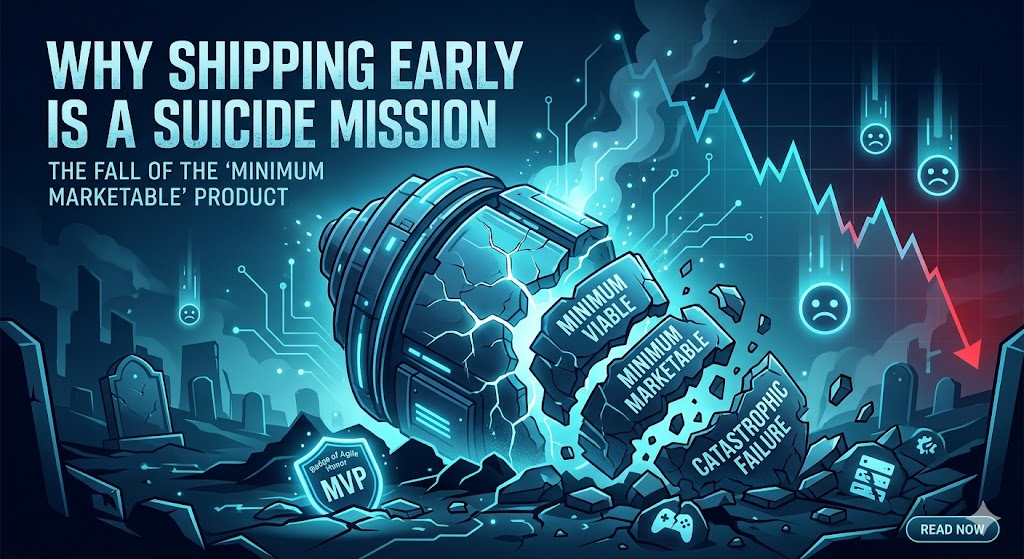
It sounds like we’re diving into the graveyard of “Early Access” and “Version 1.0” disasters. The philosophy of “Move Fast and Break Things” has officially hit a wall, and unfortunately, that wall is made of disappointed customers and tanking stock prices.
Rich Vogel talked about this at recent the Live Games Summit in Austin. In the tech and gaming world, “MVP” (Minimum Viable Product) used to be a badge of lean, agile honor. It was the promise of a foundation that would grow with its community. But somewhere between the Silicon Valley whiteboard and the digital storefront, the definition changed.
Today, “Minimum Viable” has been replaced by “Minimum Marketable,” and the results are catastrophic. Here is why shipping early—once the ultimate startup flex—has turned into a suicide mission.
“Fix it in Post” Fallacy
We’ve entered an era where developers treat a launch date like a suggestion and a Day One patch like a magic wand. But here’s the reality: You cannot patch a lost reputation.
In 2026, the market is too crowded for second chances. If a user downloads an app or boots up a game and encounters a “Product under construction” experience, they don’t wait for the roadmap. They delete, refund, and leave a one-star review that lives forever on the internet’s permanent record.
“Viable” Part is No Longer Negotiable
The original goal of an MVP was to test a core hypothesis. Somewhere along the line, companies started using it as an excuse to ship unfinished work.
-
The Old MVP: A basic car that drives, but doesn’t have AC yet.
-
The New MVP: A steering wheel and a promise that the wheels will be delivered in Q3.
When you ship without the “Viable” components, you aren’t testing a product; you’re testing your customers’ patience. In a world of infinite alternatives, that’s a test you will lose every single time.
High Cost of “Low Quality”
There is a hidden tax on shipping early. When you release a half-baked product, your entire development team pivots from innovation to damage control.
“Shipping a broken product doesn’t give you a head start; it gives you a debt that carries a 500% interest rate in the form of technical debt and lost brand equity.”
Instead of building the cool features promised for Version 2.0, your engineers are spending 100% of their time fixing the bugs that should have been caught in Alpha. It’s a loop of mediocrity that many companies never escape.
Evolution of the MVP: Then vs. Now
| Feature | The Classic MVP (Success) | The Modern “Suicide” MVP (Failure) |
| Core Goal | Validate a single, working feature | Meet an arbitrary quarterly deadline |
| User Experience | Simple but polished | “Janky” and frustrating |
| Feedback Loop | Genuine dialogue with early adopters | Constant apologies and “Roadmap” graphics |
| Market Impact | Organic growth and curiosity | Immediate “Review Bombing” and churn |
The Verdict: Quality is the Only Survival Strategy
The “Suicide Mission” happens when leaders prioritize the date over the experience. We’ve seen it with AAA games that launched as “Live Services” only to be shut down in six months, and we’ve seen it with “Revolutionary” AI apps that were really just wrappers for broken APIs.
The new gold standard isn’t the MVP—it’s the MLP (Minimum Lovable Product). If your users don’t love the core of what you’ve built on day one, they won’t stick around to see what it becomes on day 100.